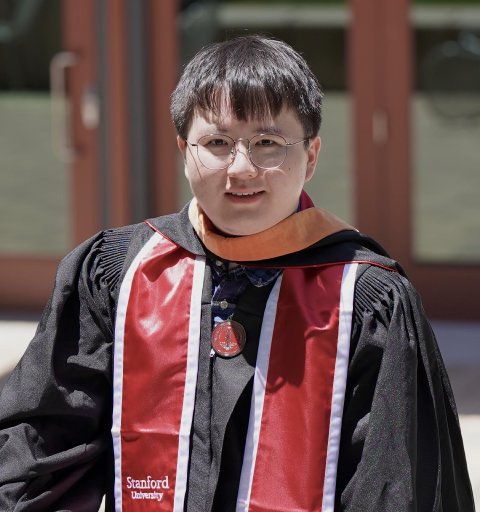
I’m a PhD student at Stanford. I earned my bachelor’s degree at the University of Wisconsin-Madison and my master’s in computer science at Stanford.
My research focuses on computer graphics, neural rendering, and systems engineering. I’m working on ways to bring representations, algorithms, and systems engineering practices from traditional graphics to neural graphics and diffusion models. I believe the future of graphics and image/video generation won’t be fully learned or fully rasterized/ray-traced. I see hybrid architectures as a way to improve representation learning, efficiency, and scalability.
Work Experience #
NVIDIA #
Neural Graphics Team, Santa Clara, CA
I worked on low-level kernel optimization in FlashDreams, NVIDIA’s interactive video and world model inference engine.
Apple #
Sensing & Connectivity Team, Cupertino, CA
I built an iOS system service for wireless connection and worked with Bluetooth team to prototype a secure communicantion protocol.
21 Nov 2026
Going Down the Rabbit Hole of Frechet Distance Derivation
If you’ve read papers on generative models, you’ve probably seen Fréchet Inception Distance (FID) in a table of results for generated images. I went back to FID recently because I wanted to understand why we’d evaluate a model this way and work through the math myself.
Why are generative models hard to evaluate? #
Say we’re training a model to generate cat photos. The model defines a distribution $p_{\theta}$ that we want to be close to the distribution of real cat photos. To get a photo out of it, we draw a sample $x \sim p_{\theta}$.